The Plastic-Body Inverter: How Chic Became India Today's Innovation of the Decade
Kunwer Sachdev on India's first plastic-body inverter — the Chic, launched at Su-Kam in the mid-2000s. Named Innovation of the Decade by India Today. Why we chose plastic when the entire industry used metal, and how it democratised power backup for Indian homes. Part 03 of Source Code of an Industry.
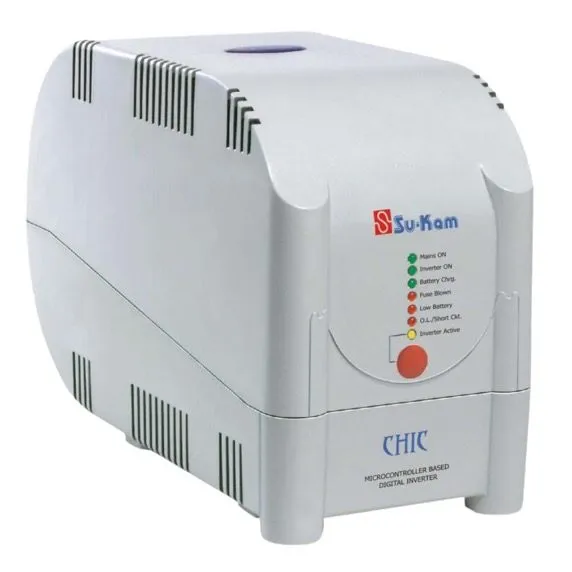 India's first plastic-body inverter — the Su-Kam Chic. India Today named it "Innovation of the Decade" for the Indian power backup industry.
This is Part 03 of Source Code of an Industry. Earlier posts covered the two foundational engineering inventions — the 1998–2000 MOSFET inverter and the 77-patent R&D portfolio (2003–2017). This post is about the invention that took our engineering platform out of the workshop and into millions of Indian living rooms — the plastic-body inverter.
The problem with metal-body inverters
Every inverter sold in India in the 1990s and early 2000s was housed in a metal box. Cold-rolled steel, powder-coated, angular, industrial. They looked like power tools. They were heavy. They rusted at the seams. Their sharp corners were a hazard in a home. Their metal shells were conductive — so any internal fault could energise the case and put a family at risk. And they were ugly. In a middle-class Indian living room, the inverter was the object you tried to hide.
Nobody in the industry had thought to ask: why does an inverter have to be a metal box?
The metal shell was inherited from industrial UPS design, where it made sense — machine rooms, cool corners of a factory, invisible to the customer. But we were not selling to factories anymore. By 2004–2005, we were selling to Indian families, and the object we were shipping did not belong in a family's home.
I asked our design team a simple question: can we build an inverter that a family would want to display, not hide?
The three problems we had to solve
Moving an inverter body from metal to plastic was not a cosmetic change. It required us to solve three real engineering problems:
1. Heat. Inverters run warm. A power stage dissipating 40–60 watts of continuous heat inside a plastic case will melt or warp if the plastic and the internal thermal design are not right. We had to redesign the airflow path, position the MOSFET heatsinks so hot air exited through top vents by natural convection, and choose a plastic grade that stayed dimensionally stable at 80 °C internal temperature for years.
2. Electromagnetic and mechanical safety. Metal grounds itself; plastic does not. We had to engineer double-insulated construction, add internal shielding where required, and design for compliance with Indian and international safety standards without a conductive shell to fall back on. Ironically, the plastic body ended up being safer than metal for the customer — no shock risk from an energised case.
3. Cost and manufacturability. A plastic housing needs a mould, and moulds are expensive. To justify the mould we had to commit to a scale of production the industry had never seen at that time. We committed. We built the tools. We designed for injection moulding — draft angles, wall thicknesses, snap-fit assembly, no external screws visible on the front face.
Enter Chic
The product we shipped was called Chic.
The name was deliberate. We wanted the customer to feel that owning this inverter said something about them — that they had chosen a modern, well-designed product, not a workshop-grade box. Chic was compact, curved, light, and — for the first time in an Indian inverter — it looked good on a wall.
Chic was followed by Fairy Queen, another plastic-body variant, and later by a whole family of plastic-body products that ran the same internal MOSFET + microcontroller platform we had been building since 1998–2001, but wrapped in industrial design that the industry had never attempted.
India Today — "Innovation of the Decade"
The recognition that mattered most came from India Today, which named the Su-Kam plastic-body inverter its "Innovation of the Decade" for the Indian power backup industry.
This was not a paid feature. It was editorial recognition that a single product design change — moving from metal to plastic — had democratised power backup in India. It made the inverter something a family could accept in the living room instead of hiding in the utility area. It made the product accessible, aspirational, and safe.
What it did to the industry
Within two to three years of Chic's launch, every serious Indian inverter brand had moved to plastic. Metal-body inverters, which had been the industry standard, became the low-end product. The visible product shelf in electronics stores across India transformed — bright plastic bodies with curved corners replaced the grey metal boxes that had defined the category for a decade.
This is a repeating pattern in this series. The 1998 MOSFET decision, the 2001 microcontroller decision, and now the plastic-body decision — each was a single technical or design choice that the entire industry copied within eighteen to thirty-six months. Not because we forced them to. Because once the customer had seen the better product, there was no way back.
Why this belongs in the R&D story
The plastic-body inverter is not in the 77-patent portfolio. Industrial design in that era was rarely patented — it was protected by tooling costs, brand identity, and first-mover advantage. Chic's protection was that competitors would need to invest in their own moulds and their own design teams to catch up, and by the time they did, we had moved on to the next product cycle.
But the plastic-body decision is R&D. Deciding to fit sophisticated power electronics into a purpose-designed injection-moulded consumer housing — and to do it safely, thermally, and manufacturably at scale in India — was an engineering programme, not a cosmetic exercise.
The proof stack
- India Today recognition — "Innovation of the Decade" for the plastic-body inverter, documented across kunwersachdev.com and the verified Su-Kam / Su-vastika digital archive
- Product photographs — original Chic and Fairy Queen product shots from the Su-Kam catalogue archive
- Industry adoption — every major Indian inverter brand launched plastic-body variants within three years of Chic; the industry standard permanently shifted
- External media — APN News, Deccan Herald, Suvastika archive, Wikipedia
What comes next
- Part 04 — From modified sine wave to pure sine wave: DSP inverters (Patent 241612) and the second architectural shift
- Part 05 — Home UPS: creating a product category that did not exist
For the two foundational inventions that started this industry, see Part 01. For the full 77-patent R&D discipline that made everything after 2003 possible, see Part 02.
Disclaimer: This post documents work executed by Su-Kam Power Systems Limited between 1988 and 2018. Su-Kam was placed in liquidation by NCLT order dated 3 April 2019. Kunwer Sachdev has had no role in Su-Kam management since then. This blog is not published on behalf of, nor is it an endorsement of, any person or entity currently carrying on business under the Su-Kam name.

More from the Knowledge Base
When the Ah Rating Disappears: How Local Battery Brands Hide the Number That Matters Most
7 Jun 2026
The Charging Current Nobody Prints on Your Inverter Battery — And Why People Are Dying
7 Jun 2026
6 Questions You Must Ask Before Buying an Inverter Battery in India
7 Jun 2026
How Much Backup Do 150Ah and 200Ah Batteries Really Give? My Lab Tests, in Plain Words
7 Jun 2026