Seventy-Seven Patents: The R&D Legacy of Su-Kam Power Systems, 2003 to 2017
Kunwer Sachdev on the 77 patent applications Su-Kam Power Systems filed at the Indian Patent Office between 2003 and 2017 — the portfolio, the five technology families, the twelve granted patents with numbers, the filing discipline, and the five 2017 forward-looking provisional applications. Part 02 of Source Code of an Industry.
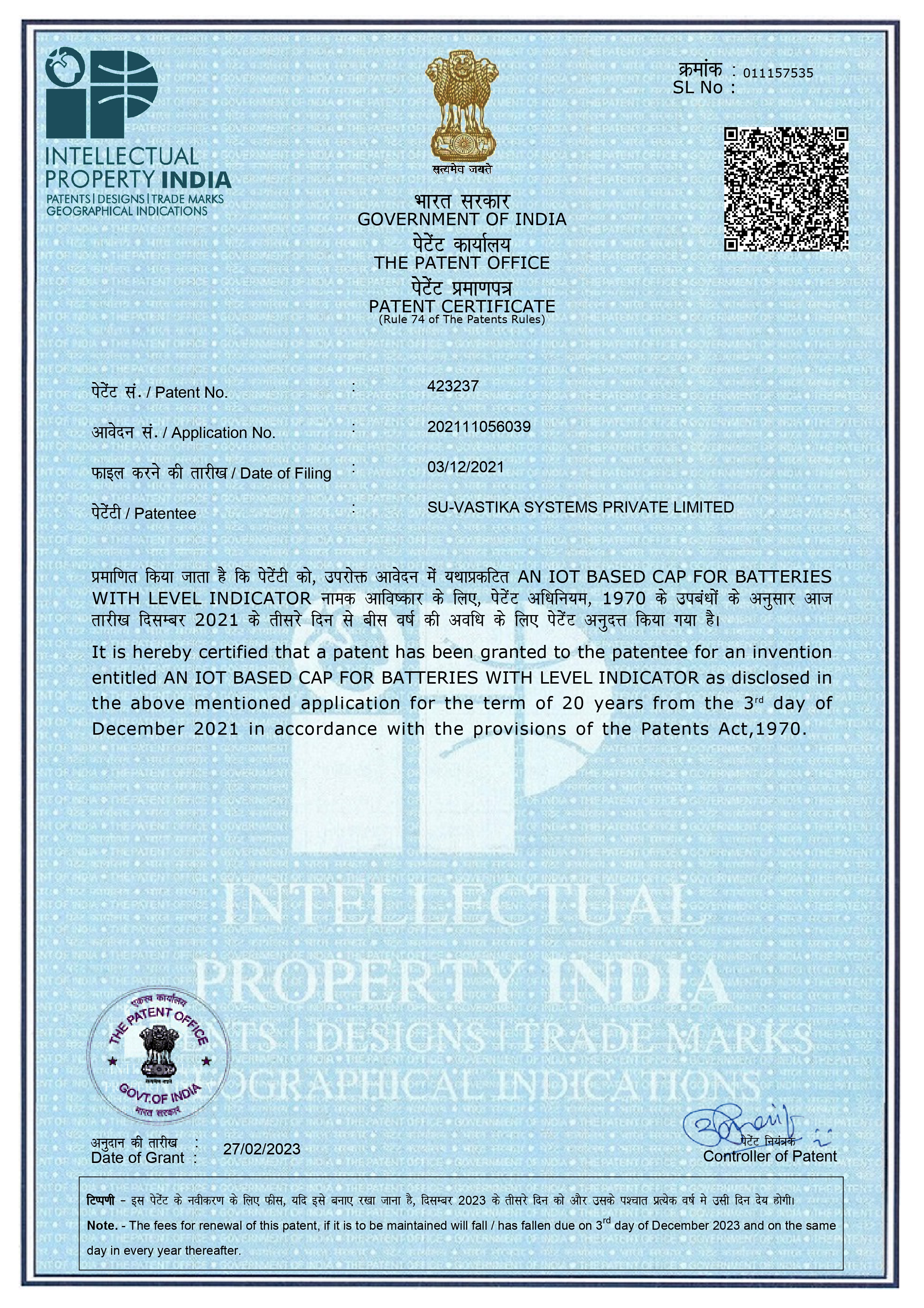 One of Su-Kam Power Systems' granted Indian Patent Office certificates — part of the 77-patent R&D portfolio filed between 2003 and 2017.
This is Part 02 of Source Code of an Industry — the R&D and product history of India's inverter industry, written from the founder's chair. If you have not read Part 01 — From Analogue to PIC16F72: The Two Inventions That Started India's Inverter Industry, start there. Part 01 covers the 1998 MOSFET inverter and the 2001 PIC16F72 microcontroller inverter — the two India-first inventions that predate the patent portfolio described here.
Between 26 May 2003 and 31 October 2017, Su-Kam Power Systems filed seventy-seven patent applications at the Indian Patent Office. Most Indian power-electronics companies in that period filed none. We did not start out planning to file 77. We started by filing one — on digital signal processing for sine wave inverters — and then kept going for fourteen years.
The portfolio in numbers
- Total applications filed: 77
- Filing window: 26 May 2003 to 31 October 2017
- Peak filing year: 2009 (23 applications)
- Other heavy years: 2008 (10), 2011 (10), 2007 (9), 2013 (6)
- Final filing burst: 5 forward-looking provisional applications in September–October 2017
- Granted (verifiable at IPO): 12 with published patent numbers as of Su-Kam records — 241612, 286639, 283006, 274370, 284856, 291088, 285567, 275276, 292773 (MPPT solar charge controller), 291664 (electro-pneumatic core stacking machine), 292452 (battery protection device), 292505 (user-settable power backup with multiple output)
- Refused: 3 (high-frequency sine wave inverter 2004, power protection with delay switch 2008, FPGA single-phase high-frequency inverter 2008)
Every application is on the public record at the Indian Patent Office and verifiable at iprsearch.ipindia.gov.in.
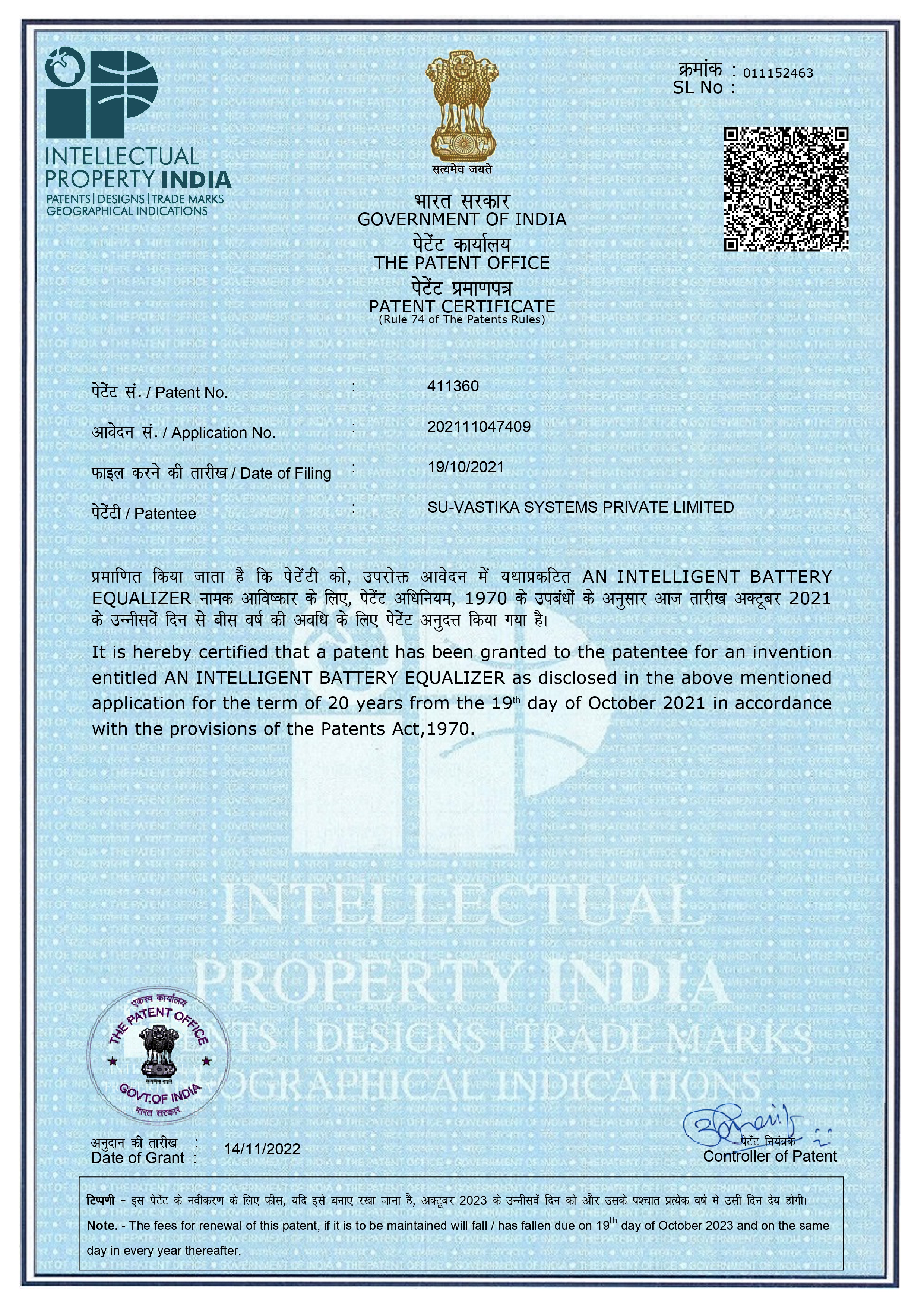 A second granted patent certificate from the Su-Kam portfolio — the twelve granted patents cover DSP inverters, MPPT solar charge controllers, battery protection, transformer core stacking machines, and more.
A historical detail — the applicant name change
The first three patents (2003–2004) were filed under SU-KAM COMMUNICATION SYSTEM LTD — the company's original cable TV era identity. From patent #4 (August 2006) onwards, the applicant name changes to SU-KAM POWER SYSTEMS LTD. The patent register itself documents the company's transition from communications to power electronics, on the same year the Digital Signal Processing Sine Wave Inverters patent (Patent No. 241612) was granted.
What each patent actually cost
- R&D cost per patent: approximately ₹5 lakh in engineering time
- Patent attorney fees per patent: approximately ₹2 lakh for drafting, filing, and prosecution
- Time from filing to grant: approximately 10 years on average
Across seventy-seven applications, this represents more than a decade of cumulative investment in original technology that no Indian competitor was making at comparable scale.
The filing discipline — file only when validated
Our internal patent policy was unusual. We filed only when the technology was already validated and working in the field. We did not file on speculative ideas, on prototypes, or on architectural sketches. Our discipline was: build the technology, install it in real customer locations, observe how it behaves under Indian operating conditions, and only then file.
This is why the patents in the portfolio are unusually robust. They are not concept patents. They are documentation of things we had already built and shipped.
Five families of technology
1 · The inverter platform
- DSP sine wave inverters (2003 · Patent 241612)
- High-frequency sine wave inverter (2004)
- DSP-controlled triple-conversion online UPS with remote monitoring (2007 · Patent 284856)
- Heavy-duty three-phase inverter with RS-232 and GSM connectivity (2007)
- Colossal DSP sinewave inverter with mobile interface and GSM connectivity (2007 · Patent 285567)
- Heavy-duty three-phase inverter for telecom industry (2007 · Patent 275276)
- High-frequency inverter (2007 · Patent 291088)
- FPGA-based inverters (2008)
- Three-phase sine wave inverter/standby UPS with bi-directional converter (2011)
2 · Battery technology
- High-frequency lead-acid battery charging (2004 · Patent 286639)
- Charge equalisation, management and control of battery strings (2008)
- Inbuilt cell equalisers (2009)
- Battery protection device (2009 · Patent 292452)
- Intelligent battery charger (2009)
- Three-phase input battery charger with power factor correction (2008)
- Improved cap for lead acid battery to improve performance (2013)
- Improved cap for lead acid battery with level indicator (2014)
Battery management is where most off-grid and solar deployments succeed or fail. Getting this right is what turned a working inverter into a working product.
3 · Solar — the foundation of Solarcon and Brainy Touch
 India's first DSP-based high-voltage MPPT solar charge controller — the working product behind Patent 292773, built before solar was mainstream in India.
- MPPT-based solar charge controller (filed 2008, granted 2018 as Patent No. 292773) — the foundational solar filing
- Solar grid hybrid subsystem (2011) — the architectural insight behind Solarcon, which converted any existing inverter and battery setup into a solar system without requiring the customer to discard equipment they already owned
- Remote monitoring of solar/renewable systems (2011) — the architectural insight behind Brainy Touch, the Wi-Fi-enabled, smartphone-monitored solar power system that Wikipedia today records as "India's first touchscreen solar PCU"
- Solar Power Conditioning Unit with Dynamic Depth of Discharge Control (2013)
- Solar Power Conditioning Unit with Prepaid Metering (2013) — a decade before "pay-as-you-go solar" became an industry model
- Hybrid Solar Charge Controller (2014)
- Solar charge controller with multiple arrays (2009)
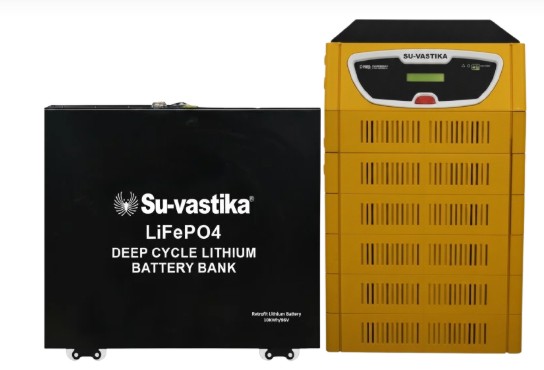 A Su-Kam 10 KVA MPPT Solar PCU with a 9 KWh LiFePO4 battery — the kind of hybrid solar system the 2008 MPPT patent and the 2011 solar-grid hybrid patent made possible.
4 · Application-specific power backup
We did not treat "power backup" as a generic problem. We engineered for the application:
- Fuel dispensers and fuel pump stations (2009)
- Lifts and elevators (2009)
- Cooling devices (2009)
- Treadmills (2009)
- Photocopy machines (2009)
- ATMs (2009)
- Off-road vehicles (2010)
- Battery charging stations (2009)
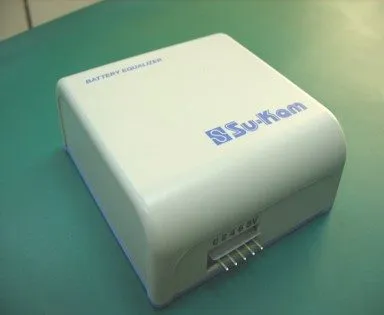 Power on Wheels — a 100 KVA inverter mounted on a truck that toured India in the mid-2000s to prove Indian-made high-capacity power backup to Indian customers, dealers, and government buyers.
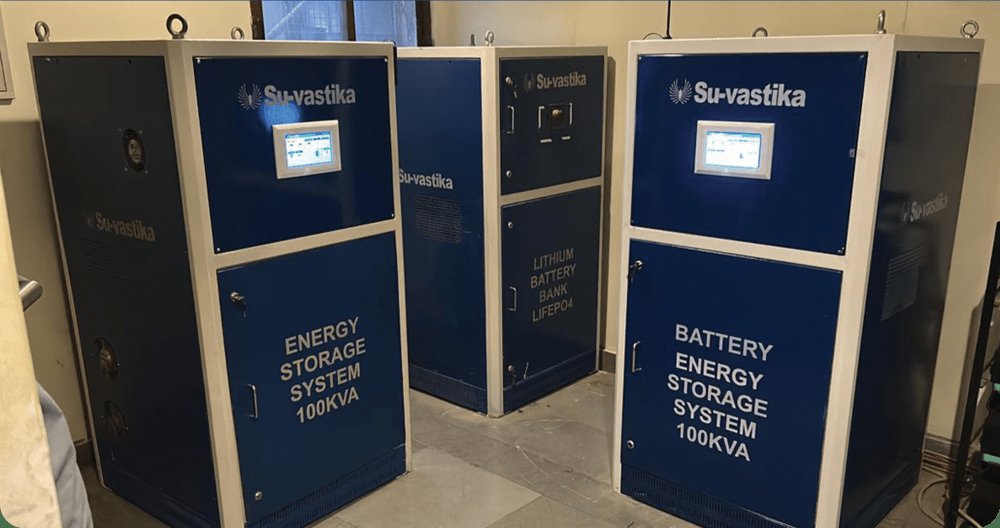 A Su-Kam 100 KVA BESS (Battery Energy Storage System) — built on the patented inverter platform that started with the 2003 DSP sine wave inverter filing.
5 · Manufacturing intellectual property
Patents on the equipment we used to make our own products:
- Automated testing system (2008)
- Automatic burning apparatus (2008)
- Electro-pneumatic core stacking machine (2008 · Patent 291664)
- Automatic welding machine for transformer cores (2012)
- Automatic test rig for transformers (2011)
- High-rate discharge battery test system (2011)
- Automatic testing apparatus for functional testing of PCBs (2011)
Su-Kam was inventing not just products, but the machines we used to manufacture our products. Very few Indian power electronics companies had that depth.
The unusual ones
Some patents in the portfolio deserve a mention on their own, because they were unusual for their time:
- Power Source with Hand Cranking (2009) and Power Source with Foot Cranking (2009, granted concept) — off-grid rural India solutions when the mainstream industry was ignoring the rural energy problem
- Automated Switch Panel with Two Way Communication (2009) — the beginning of the networked-appliance thinking that later became IoT
- Novel Push-Pull Based Isolated Bidirectional Power Converter (2013) — the topology innovation behind our bidirectional inverter work
- A Method for Increasing Efficiency of H-Bridge Boost Converter for Battery Charging (2013) — pure power-electronics IP
- Interactive Solar Educational and Experimental Kit (2007 · Patent 283006) — because you don't build an industry without building the engineers who will maintain it
The five 2017 forward-looking filings
The most consequential filings in the portfolio are the five provisional applications filed in September and October 2017 — six months before the CIRP process began at Su-Kam:
- 8 Sep 2017: Grid Tied Inverter System (201711031827)
- 7 Oct 2017: System for Sharing Battery Charging and Discharging Current Between PV-Grid and PV-Load (201711035630)
- 7 Oct 2017: Method and System for Power Flow Management in Multifunctional Battery-Integrated Grid-Interactive PV Generation System (201711035631)
- 7 Oct 2017: Method and System for Triangulation of Power Backup Devices for Control and Maintenance (201711035632)
- 31 Oct 2017: Solar Photovoltaic System with Transformer Isolation (201711038692)
These five filings, together, were the architectural plan for what Su-Kam expected to build in the next product cycle: grid-tied, battery-integrated, bidirectional, multifunctional, networked. The insolvency process closed the door on that specific execution, but the ideas moved forward to Su-vastika, which has filed a further 25 patents between 2019 and 2024 — bringing the founder's lifetime total to 102 patents across two companies.
Why this matters for the industry story
Filing 77 patents is not the point. The point is what those 77 filings document: a fourteen-year period in which one Indian company was doing systematic industrial R&D in power electronics at a scale and cadence no competitor was matching. The patents are the paper trail. The products they describe are what created the modern Indian inverter, UPS, and solar power backup industry.
What comes next in the series
- Part 03 — The plastic-body inverter: how Chic became India Today's "Innovation of the Decade"
- Part 04 — From modified sine wave to pure sine wave: DSP inverters and the second architectural shift
- Part 05 — Home UPS: creating a product category that did not exist
For the two inventions that predate this patent portfolio, see Part 01 — From Analogue to PIC16F72: The Two Inventions That Started India's Inverter Industry.
Sources:
- Indian Patent Office Public Search — iprsearch.ipindia.gov.in
- Wikipedia — Su-Kam Power Systems
- Wikipedia — Kunwer Sachdev
- pv magazine India, 5 March 2018
- Verified digital archive — solarmanofindia.com/patents
Disclaimer: This post documents work executed by Su-Kam Power Systems Limited between 1988 and 2018. Su-Kam was placed in liquidation by NCLT order dated 3 April 2019. Kunwer Sachdev has had no role in Su-Kam management since then. This blog is not published on behalf of, nor is it an endorsement of, any person or entity currently carrying on business under the Su-Kam name.
More from the Knowledge Base
When the Ah Rating Disappears: How Local Battery Brands Hide the Number That Matters Most
7 Jun 2026
The Charging Current Nobody Prints on Your Inverter Battery — And Why People Are Dying
7 Jun 2026
6 Questions You Must Ask Before Buying an Inverter Battery in India
7 Jun 2026
How Much Backup Do 150Ah and 200Ah Batteries Really Give? My Lab Tests, in Plain Words
7 Jun 2026