
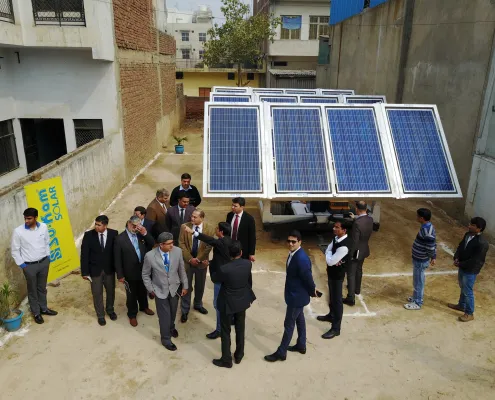
In this expert insight, industry veteran Kunwer Sachdev discusses how Su-Kam conceived, built, and deployed India’s first 3-phase Solar Power Conditioning Unit (PCU) in 2006 — a full six years before the government’s National Solar Mission made solar a national priority — at a time when panel costs were ten times today’s prices and no installation playbook existed.
The lesson: you cannot wait for a technology to become affordable before you learn to install it. By the time the price drops, you need to already know everything the price had been hiding.
The India Angle: Why This Matters to the Solar & Inverter Industry Today
India’s solar capacity crossed 100 GW in 2024 and is racing toward the government’s 500 GW target by 2030. Three-phase solar inverters and hybrid PCUs are now mainstream — sold by dozens of brands, installed by thousands of EPCs. But in 2006, when Su-Kam deployed its first 3-phase Solar PCU, none of this infrastructure existed. No mounting standards, no DC cabling norms, no trained solar electricians, no commissioning protocols for high-voltage DC systems.
Kunwer Sachdev’s account is not nostalgia. It is a precise technical record of how India’s solar engineering knowledge base was built — site by difficult site — by pioneers who had no playbook to follow and had to write one themselves.
Key Highlights
- Conceived in 2004, deployed in 2006 — Su-Kam’s Solar PCU predates India’s National Solar Mission (launched January 2010) by six years. Over 50 sites across India were commissioned and running.
- Full hybrid architecture integrating five major subsystems:
- MPPT (Maximum Power Point Tracker) with Hall Effect current sensing on PV input — more accurate than resistive shunting in high-current outdoor environments
- Bidirectional inverter — converting solar/battery DC to AC for loads, and grid AC to DC for battery charging
- 3-phase Y/Y isolation transformer — stepping voltage up to three-phase grid levels
- 360V DC battery bank — high-voltage design reducing current and cable losses
- CT-based relay changeover — sensing all three phases (R, Y, B) on input and output for accurate power measurement
- Panel costs in 2006: ₹300–400 per watt (vs. under ₹25/watt today). A 5kW system cost ₹15–20 lakh in panels alone — making every installation a major capital decision, not a consumer purchase.
- Real-world engineering challenges that no textbook covered:
- No established DC cabling or earthing standards for high-voltage solar systems in India
- Power electronics behaved differently on Rajasthan rooftops in May vs. Gurgaon labs in November — thermal derating learned from real sites
- Three-phase load imbalance handling — complex in practice despite looking simple on a diagram
- Every service visit was expensive, driving Sachdev’s conviction that remote monitoring was “structurally necessary” — which led directly to Power NMS
- Why Su-Kam stopped scaling it: The PCU worked. The barrier was panel pricing. Rather than mass-produce a product constrained by external costs, Sachdev pivoted R&D to the next technology layer — a strategic decision that would define Su-Kam’s innovation trajectory for the next decade.
- What 50+ installations delivered that money cannot buy: Complete cycles of design, commissioning, fault-finding, and service at real Indian sites — embodied knowledge that no consultant’s report could replicate and that became the foundation for every solar product Su-Kam built afterward.
Expert Perspective
Sachdev writes with characteristic clarity: “You cannot wait for a technology to become affordable before you learn to install it, commission it, and service it. By the time the price drops, you need to already know everything the price had been hiding.”
And on the difficulty of being first: “The hardest thing about pioneering technology in a new market is that every problem you encounter is a problem nobody has solved before. There is no forum to search, no colleague to call, no case study to read. You solve it, you write it down, and that piece of paper becomes the next generation’s starting point.”
Then vs. Now: India’s 3-Phase Solar Market
| 2006 (Su-Kam Pioneer Era) | 2026 (Current Market) |
|---|---|
| ₹300–400/watt panel cost | Under ₹25/watt |
| No DC cabling or earthing standards | BIS/IEC standards established |
| 50+ sites, all custom-engineered | Millions of installations annually |
| No trained solar electricians | MSDE-certified solar workforce |
| 3-phase PCU was experimental | 3-phase hybrid inverters are mainstream |
| 6 years before National Solar Mission | India targeting 500 GW by 2030 |
Source: KunwerSachdev.com — “We Built India’s First 3-Phase Solar System in 2006 — Six Years Before the Government Called It a Priority” (Published: May 1, 2026)
Original URL: https://kunwersachdev.com/we-built-indias-first-3-phase-solar-system-in-2006-six-years-before-the-government-called-it-a-priority/